Before we look at domaining we need to first look at why a domain name can be so valuable to certain people.
Basically, everyone that wants to have a website whether it’s a business, personal, charity or any online entity they will need to start with a domain name. Domains names can help with the branding of a business, it is important that the domain name of a business uses matches their brand and what they are trying to sell.
Domains can also be used a short description of a business and tell the customer what they offer, whether it be a product or service. For example, FredPizza.com. Domains can also be purchased solely to be used as an email address for an offline business.
What is a Domain Name made up of?

Now let’s have a look at what makes up a domain name, it is important you can use and understand the terminology as it will help you with your credibility within the domaining world.
An example of a domain name is www.seoaccounts.net. In this case www is known as the subdomain, seoaccounts is the domain, .net is the extension or TLD.
An important note, make sure you are calling it a domain name when talking about it with other domainers and defiantly do not call it a link or url as this will instantly kill your credibility.
What is Domaining?
So now we know what a domain is and why a domain can be important to certain people, so let’s now look at what domaining is.
In a nutshell domaining is the process of buying a domain name with the intention of selling it at a higher price to either another domainer or an end user.
Note that you will get a larger return on your investment selling to end users, as a fellow domainer would also be looking to make a profit selling the domain name on to an end user.
Simply put the process involves researching domain names until you find one that could be profitable and purchasing it for a low price and then finding a buyer and selling it a higher price.
Now this is important, the key part of domaining is in buying the right domain name, I would say about 90 percent of domaining is in selecting the right domain names. But don’t worry I will be showing you how to do the research to find the best domain names out there.
Domaining is a business that requires time, small amount of money to purchase domain names, effort and patience. This is not a click button get rich quick scheme, domaining can make you rich but you have to do some work for it.
It is an evergreen system, so it is here to stay as long as we have the internet and people using it.
Registry – Registrant – Registrar
Now let’s talk about the differences between a registry, registrant and registrar.
A registry holds all the information about domains. A registrar is the likes of GoDaddy or Dynadot that pay the registry to be a registrar and per domain registration and a registrant is you or me that purchases the domain.
You do not need to know these terms off by heart but it helps to understand how it works.
Types of Domain Names
Domain names can be categorized into a number of types, it is good to understand what each are as it will help build your credibility when you talk to other domainers.
● ccTLD – country code Top Level Domains – Two letter domains established for geographical locations; for example; .au signifies Australia. Some of these domains can only be purchased by residents of these country’s or if they have significant business interests within the country.
● gTLD – generic Top Level Domain – The best known generic TLD’s include .com, .net, .biz, .org and .info – these can be registered by anyone, anywhere in the world.
● IDN ccTLD – internationalized country code top-level domains – A top-level name with a specially encoded format that allows it to be displayed in a non-Latin character set (i.e. special characters).
Genres of Domain
Domain names can be grouped by many different genres, these are a few:
● Brandable – A brand can be built around the domain name, an example would be something like Uber.
● Geographical – Usually made up of a CityService or ServiceCity e.g. NewYorkLawyer.com or LondonBuilder.com
● Keyword – Domain that contains a keyword for product or service e.g. RunningShoes.com or PhoneCovers.net
● Numeric – Made up of only digits, these domains are popular in the Chinese market place.
● Traffic – Domains that have traffic coming to it, either from search engines, directly or from previously created backlinks by a past domain owner.
These are only a few of the genres you will come across on your domaining journey but they are the most popular when starting out.
Buying Domain Names
When it comes to buying a domain, picking the right name will be to your success. We will be looking at the number of factors that can affect the value of a domain name.
You will see a number of paid and free appraisal schemes out there; do not use there as they are never very accurate and at the end of the day a domain is only worth what someone is willing to pay.
What makes a good Domain Name?
There are a range of things that can make up a good domain name, here are some of the main things to think about when buying a domain name:
● Common Sense – this is a key part of deciding if a domain name is good or not, this will improve in time as you learn more about domaining, e.g. a domain made up of random letters and numbers is not going to be very valuable.
● Grammatically Correct – if it doesn’t make sense grammatically then it is usually not a good domain name, e.g. BethFlower.com vs BethsFlowers.com. However, sometimes if the domain name is something that could be brandable then the grammar may not be an issue.
● Does it sound right – Say the domain out loud, does it make sense and is it easy to pronounce.
● Niche – Is the niche size large enough to give you a number of potential buyers. You can find the niche size by using Google to see the number of search results, as well as Facebook and LinkedIn to check for groups/companies/people that could use the domain name.
● Shorter the better – The shorted the domain name the better as it will be more memorable and easier to read.
● Domain Spam History – The history of the domain can be useful to see what it was used for before, you can use a site called archive.org to check what was previous on the domain name.
● Comparable Previous Sales – Check for domain names that are similar and what they have sold for in the past, there are a number of sites you can use such as NameBio.com and DnPric.es
● Seasonality – The less seasonal the better, for example a Christmas based domain will only be valid around Christmas.
Where to purchase your domain from?
When it comes to purchasing a domain there are a number of places to get the domain name from
All available names can be purchased directly from the registrar such as DynaDot and GoDaddy.
If someone already has the domain name you can try and purchase it directly from the domains current owner.
There are also a number of market places such as namepros.com or flippa.com.
There are auction sites such as Flippa and GoDaddy that allow you to place bids on domain names, you can sometimes get some good deals here.
For this guide we are going to focus on the place I get most of my expired domains and is a good starting point for any new domainer. It is a site called ExpiredDomains.net.
As you can see from the screenshot there is over 300 millions deleted domains meaning these domains have been bought before and the previous owner has not renewed it.
This could mean a number of things about the domains; the previous owner might no longer have a need for the domain, it might have been bought by another domainer and they failed to sell it or the previous owner just forgot to renew it.
Sign up for a free account on ExpiredDomains.net and you will then get to see a screen like this:
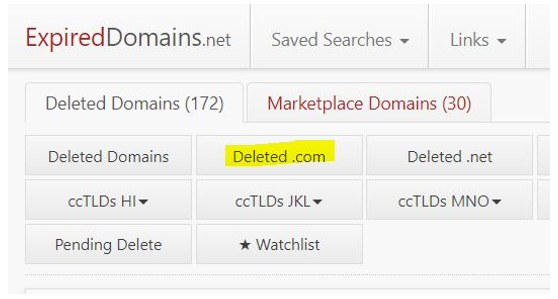
Just click on the deleted .com button and you will get to see all the deleted .com domain names, .com is a good starting place for any domains as there is a saying in the domaining world; ‘.com is King’
As you can see below there are currently over 2 million deleted .com domain names, to help filter this down and make it more manageable I add some filters to my search, just click on the Show Filter button to do this.
The filters I like to use are no numbers, no hyphens, only new last 24 hours and English dictionary words.
I choose no numbers and hyphens as I have found that domain names with just english words sell much better. The only new in past 24 hours filter is just my way of narrowing down the list further, in my experience most of the good names have been snapped up if they have been available for more than 24 hours. Finally, the English dictionary words are key as you only want to see domain names that make sense.
If you are searching for a certain Niche you can use the Domain name whitelisting section of the filters to look for domains that contain a certain word.
BONUS TIP
Using the white listing is a great way to find location domain names, for example if you put London into the starts with or ends with boxes you will get a list of domains that relate to the city of London.
Look for domains that have a service in them as well such as LondonBuilders.com or LondonPainters.com and these are domains that you can flip quickly to local businesses in that area.